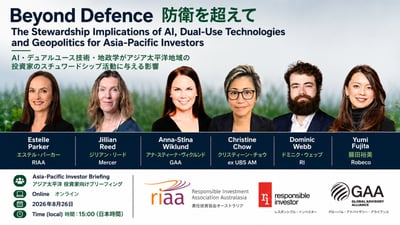
Beyond Defence: The Stewardship Implications of AI, Dual-Use Technologies and Geopolitics for Asia-Pacific Investors
Join Global Advisory Alliance and the Responsible Investment Association Australasia (RIAA) for Asia-Pacific Institutional Investor Briefing.
Published on
2026-08-20
by
 GAA
GAA
GAA

If you were leading a sustainability function today, what would you do over the next 12 months?
Part 5/5 of David Carlin's series on sustainability teams' use of AI today
Published on
2026-08-18
by
 investESG
investESG

What are the risks of AI, and what role should sustainability leaders play?
Part 4/5 of David Carlin's series on sustainability teams' use of AI today
Published on
2026-08-17
by
investESG
investESG

What are sustainability teams getting wrong about AI?
Part 3/5 of David Carlin's series on sustainability teams' use of AI today
Published on
2026-08-14
by
investESG
investESG

Where can AI have the biggest impact on a sustainability team?
Part 2/5 of David Carlin's series on sustainability teams' use of AI today
Published on
2026-08-13
by
investESG
investESG

How are sustainability teams actually using AI today?
Part 1/5 of David Carlin's series on sustainability teams' use of AI today
Published on
2026-08-12
by
investESG
investESG