Login
Welcome back to ESG.Guide
Register now to list your organisation
Please provide a correct email address.
Password must be at least 10 characters containing upper-case, lower-case and numeric characters.
Password confirmation doesn't match the original password.
List Your Organisation Here

Insights

19

Making corporate land action count

UNCCD Parties reaffirm GRI’s role in advancing land-related corporate disclosure

Published on 2026-09-18 by GRI
Read More

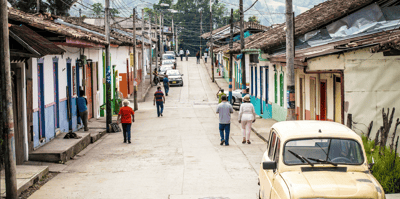
Building Colombia’s Nature Economy Could Create Hundreds of Thousands of New Jobs

As Colombia transitions to a low-carbon, nature-based economy, the right policies can help drive sustainable growth and an inclusive workforce.

Published on 2026-09-17 by WRI
Read More

Aviva case study: Tackling deforestation – a central part of our climate and biodiversity efforts | Global Canopy

Biodiversity loss is an increasingly well-recognised driver of potential financial risks, and yet the financial sector continues to contribute to the rapid decline in plant and animal species through its investment and underwriting activities. At Aviva we recognise our role in contributing to the Kunming-Montreal Global Biodiversity Framework of halting and reversing biodiversity loss by 2030 and are committed to make progress towards this goal, through implementation of our Biodiversity Policy.

Published on 2024-02-12 by investESG
Read More

Sustainability standard to accelerate accountability in the mining sector

Launch of GRI Mining Standard drills down on the impacts of the sector

Published on 2024-02-05 by GRI
Read More

Transparency standard to inform global response to biodiversity crisis

New GRI Biodiversity Standard available for use by companies around the world

Published on 2024-01-25 by GRI
Read More

Deforestation in the context of the TNFD Recommendations: leveraging prior progress, utilising existing datasets and going further with additional guidance

As a co-founder and official piloting partner of the Taskforce on Nature-related Financial Disclosures (TNFD), Global Canopy has welcomed the publication of the final TNFD Recommendations. For the first time, this provides organisations with guidance and disclosure recommendations that help them identify, disclose and act on their material nature-related issues. This is a significant step for finance and business towards a data-driven, global response to the nature crisis in a push to drive financial flows away from nature destruction towards nature positive outcomes.

Published on 2023-09-26 by investESG
Read More

Reports

5

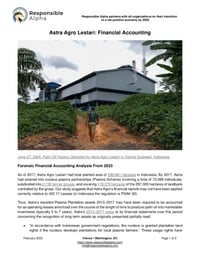
Astra Agro Lestari: Financial Accounting

Published by Responsible Alpha: As of 2017, Astra Agro Lestari had total planted area of 290.961 hectares in Indonesia. By 2017, Astra had entered into nucleus-plasma partnerships (Plasma Scheme) involving a total of 73,099 individuals, subdivided into 2,736 farmer groups, and covering 178,379 hectares of the 297,000 hectares of landbank controlled by the group. Our study suggests that Astra Agro’s financial reports may not have been applied correctly relative to IAS 17 Leases (in Indonesia the regulation is PSAK 30).

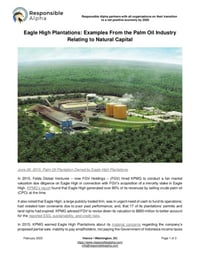
Eagle High Plantations: Financial Accounting

Published by Responsible Alpha: In 2015, Felda Global Ventures – now FGV Holdings – (FGV) hired KPMG to conduct a fair market valuation due diligence on Eagle High in connection with FGV’s acquisition of a minority stake in Eagle High. KPMG’s report found that Eagle High generated over 80% of its revenues by selling crude palm oil (CPO) at the time. It also noted that Eagle High, a large publicly traded firm, was in urgent need of cash to fund its operations; had violated loan covenants due to poor past performance; and, that 17 of its plantations’ permits and land rights had expired. KPMG advised FGV to revise down its valuation to $680 million to better account for the reported ESG, sustainability, and credit risks.

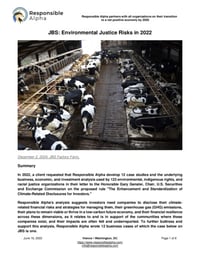
JBS: Environmental Justice Risks in 2022

Published by Responsible Alpha: Brazil-based JBS, $16 billion market capitalization, $14.6 billion in fixed income securities outstanding, 250,000 employees, is the world's largest processor of animal protein. JBS emissions rose from 280 million metric tons of carbon dioxide equivalent (MtCO2e) in 2016 to 421.6 MtCO2e in 2021 – an increase of 51 percent over five years – and 90 percent of these emissions are Scope 3 emissions driven by its cattle production and upstream deforestation and degradation. JBS climate footprint is greater than the country of Italy, yet JBS does not report on its Scope 3 emissions, which are 90 percent of its emissions.