
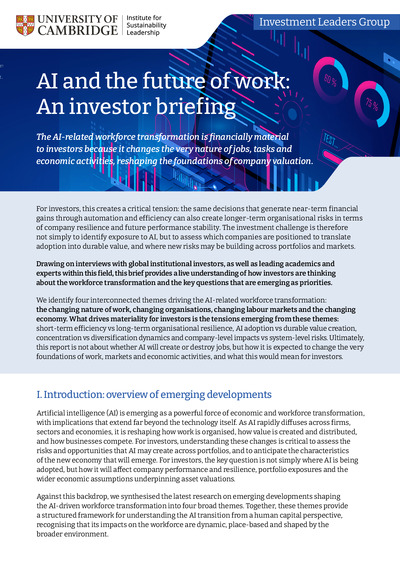
New research highlights how AI-driven workforce changes could reshape company valuations, portfolio resilience and wider financial markets, calling on investors to look beyond technology adoption to assess long-term value creation.

Photo credit: Getty Images / Unsplash+
The rapid adoption of artificial intelligence (AI) could deliver significant productivity improvements while simultaneously introducing longer-term risks to company resilience, workforce capabilities and investment performance, according to new research from the University of Cambridge Institute for Sustainability Leadership (CISL).
The investor briefing, AI and the Future of Work, developed by CISL’s Investment Leaders Group (ILG), draws on interviews with investors, academics and industry experts to explore the financial implications of AI-driven workforce transformation.
The research identifies four key tensions investors should consider:
- Efficiency versus resilience: Short-term cost savings could come at the expense of critical skills, institutional knowledge and long-term competitiveness.
- Adoption versus value creation: Widespread AI adoption does not necessarily translate into stronger company earnings.
- Diversification versus shared dependencies: Common reliance on AI technologies and infrastructure is creating correlated risks across portfolios.
- Company performance versus systemic risk: Workforce disruption could affect consumer demand, economic growth and public finances, with implications for asset valuation.
"AI has the potential to profoundly reshape organisations, societies and economies. It is therefore critical that investors understand these wider implications rather than looking at AI through a narrow technology lens. This report provides a timely and practical framework for navigating those challenges, helping investors look beyond AI adoption rates to assess organisational resilience, execution and preparedness."
Katie Elliot, Head of the Responsible Investment Centre of Excellence, Rathbones Group.
"AI will not affect every company in the same way. The real investment challenge is understanding where it strengthens an existing business model, where it erodes competitive advantage, and where management is adapting quickly enough to stay ahead. This briefing from the Investment Leaders Group helps investors focus on those signals and better assess which companies are truly prepared for the next phase of AI adoption."
Nicolas Faller, Co-CEO of Asset Management, Union Bancaire Privée (UBP), ILG Co-chair
"AI is rapidly becoming one of the defining forces shaping corporate competitiveness, productivity, and the future of work. For investors, the challenge is distinguishing genuine value creation from hype, short-term cost reduction, and longer-term organizational risk. This briefing brings much-needed clarity to that debate, offering a useful framework for assessing how governance, workforce transition and execution can help assess companies’ potential to create sustainable value from AI."
Brian Kernohan, Chief Sustainability Officer, Manulife Investment Management, ILG Co-Chair
"The AI investment story is moving beyond who is adopting technology the fastest and towards who can turn AI into competitive advantage. Much of this will depend on execution: how companies redesign work, manage their workforce and preserve the institutional knowledge they will need in the future. As AI exposure becomes almost universal, investors need to understand where these risks are concentrating across portfolios. Our new briefing examines these tensions and highlights signals investors can use to assess company preparedness and the wider portfolio implications of AI-driven workforce change."
Elliot Cyriax, Head of Investment Leaders Group, CISL
The research is the first phase of the ILG’s wider AI programme, which will next explore how investors can integrate these risks and opportunities into investment decisions and stewardship.
For more information, visit the Cambridge Institute for Sustainability Leadership.
