
A new paper presents modelling results showing efficiency gains from a European risk pool for natural perils.
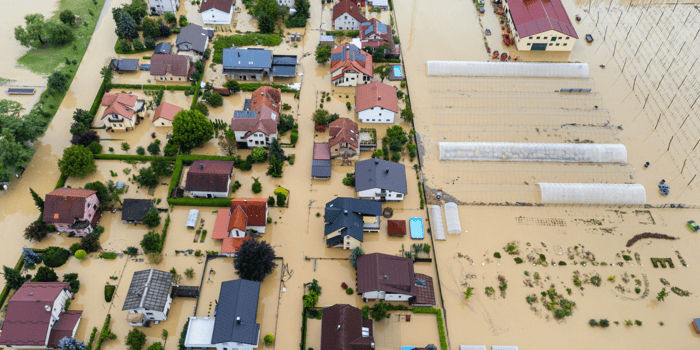
Photo credit: Getty Images / Unsplash+
The increasing frequency and severity of natural catastrophes poses substantial economic and societal challenges across Europe. As risks continue to grow, insurance coverage for such events remains insufficient, leaving individuals, businesses, and governments exposed to financial losses. This paper demonstrates how a European-level risk-sharing mechanism can deliver significant diversification benefits and enable more cost-effective funding, crowding in the private sector. This paper presents modelling results showing how efficiency gains from a European risk pool for natural perils – combined with a loan-based backstop – can enhance the overall risk-bearing capacity and substantially reduce the insurance protection gap.
Natural catastrophes impose a significant burden on society
Natural catastrophes, such as floods, heatwaves, wildfires, and storms are becoming increasingly frequent and severe, posing significant economic and societal challenges across Europe. As risks continue to grow, insurance coverage for natural catastrophes remains insufficient, leaving individuals, businesses, and governments increasingly exposed to financial losses, undermining resilience and recovery efforts.
Historical loss data and output from catastrophe models are used to explore the benefits of a risk-sharing mechanism combining a natural catastrophe insurance pool with loan-based backstop
Building on previous publications by the European Insurance and Occupational Pensions Authority (EIOPA) and the European Stability Mechanism (ESM), this paper explores the potential benefits of a European risk-sharing mechanism that combines a natural catastrophe insurance pool with a loan-based backstop mechanism. To do so, the paper considers both historical loss data and output from catastrophe models. This paper aims to provide a technical contribution to inform further discussions and decisions. It is well understood that the scheme needs to be embedded in a broader adaptation strategy and a clear policy to address demand-side deficiencies. To keep the analysis tractable, these issues are not further elaborated in this work.
A large protection gap in Europe needs to be closed
Depending on the estimation approach and the types of losses being considered, the insurance protection gap at the European level varies between 75% using historical loss data and 50% using a modelling approach. It can be even larger for individual countries and perils. There is significant variability among countries on how losses are insured.
European risk pooling unlocks efficiency gains
A European natural catastrophe insurance pool leverages the principle of risk diversification by pooling risks across countries and perils. This approach allows insurers to increase their capital efficiency, enabling them to underwrite more business and reduce the financial burden on policyholders. Individual pool members1 will benefit from joining the natural catastrophe risk pool, provided that the pool collects risk-based premiums. Even when a specific pool member is not exposed to a certain risk, it benefits from the inclusion of uncorrelated risks, which reduces overall portfolio volatility and increases stability. Model simulations show that pooling risks across countries and perils could reduce overall capital to back the aggregated risk by up to 67% compared to standalone national solutions.
A complementary backstop facility adds predictability and provides a financial safety net for extreme tail events
Complementing the insurance pool, a loan-based backstop provides initial funding and a financial safety net for extreme tail events that exceed the pool's capacity. By offering predictable and affordable funding, the backstop reduces the reliance on ad hoc government interventions and stabilises reinsurance costs for insurers. In the context of this study, simulations indicate that the backstop's required capacity ranges from €10 billion to €65 billion, depending on the risk appetite of the facility providing the loan and climate change dynamics. Over time, as the pool accumulates reserves, the likelihood of the backstop being called upon diminishes but remains critical for addressing severe scenarios.
The paper outlines a design proposal with the aim of sparking further policy discussions
This joint EIOPA/ESM project offers insights on the possible design of a European natural catastrophe insurance pool supported by a loan-based backstop facility. The analysis demonstrates how such a framework could strengthen private sector capacity, reduce volatility, and help narrow the protection gap while maintaining fiscal neutrality.
Rather than provide definitive conclusions on every aspect of the policy design, the paper focuses on outlining the potential quantitative impacts to inform policy discussions.
1 Throughout this paper we use the term pool member as a synonym for any insurer, reinsurer, natural catastrophe scheme, or any other vehicle that joins the European risk-pooling mechanism.
Published by
 investESG
investESG
