
by Mitch Reznick, Group Head of Fixed Income London at Federated Hermes Limited
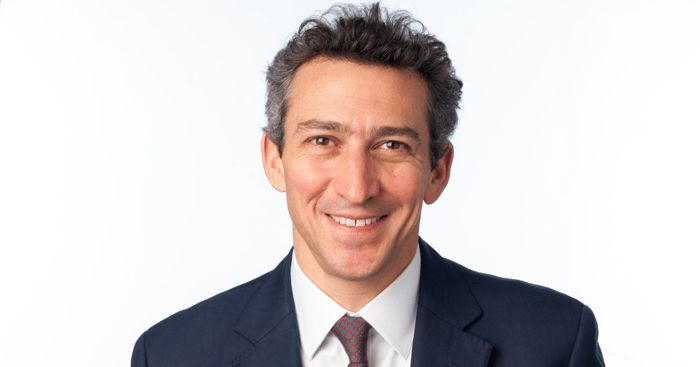
Photo credit: Federated Hermes Limited
Mitch Reznick, Group Head of Fixed Income – London, Federated Hermes Limited
The current state of sustainable finance resembles a Rorschach test. Depending on whom you speak to, it’s either moribund or thriving. We have our own interpretation of the ink blotter that is the state of sustainable finance.
Beyond the dramatic headlines that predict the slow death of the asset class, there are several factors that portray an evolving, indelible part of capital markets. Starting with the labelled bond market, the figures suggest primary issuance in sustainable bond markets for 2025 is on track to be US$1.2tn, representing a small increase versus 2024.
What makes this figure so remarkable is that the number of corporate, labelled bonds out of the US has fallen nearly 40% (1). However, there has been an impressive surge in securitised, social-labelled bonds out of the US over the last few years that continued well into 2025.
Texas ahead of California in the renewable energy sector
The state of Texas happens to be one of – if not the – leading US state investing in and adopting renewable energy. In 2024, renewable sources in Texas generated over 166 GWh of energy, ahead even of California (2).
This trend could well continue after a number of anti-renewable energy bills failed to pass into law this year. California, along with Texas and a handful of southern states, remains at the top of the league tables when it comes to investing in renewable energy (3).
From a regulatory perspective, the US is rolling back requirements for sustainability disclosures while Europe appears to be losing momentum on this front. Meanwhile, the rest of the world is pushing ahead.
In Asia, India, the UK, and Australia, the focus is on the inclusion of ‘transition’ activities in disclosures and taxonomies. This inclusion is highly sensible. If the global economy is going to pivot in a way that generates economic value in a sustainable fashion, a successful transition is imperative.
What will be the biggest catalyst for new issuance in 2026?
Expected sources of power generation – which require new capital – are a good indication of where we’re headed in sustainable finance. The International Energy Agency (IEA) forecasts rapid, sharp increases in renewables, which should, as the IEA sees it, partially displace coal (4).
There are some indications that we’re at a positive tipping point of sorts regarding the adoption of renewable energy, since installed renewable energy exceeded that of coal for the first time in 2025 (5). This transition from coal to renewables is being driven by a rapid adaption of solar and wind.
In 2024, according to Bloomberg, over 70% of new, installed global energy capacity was solar. Coal and fossil fuel-sourced energy will likely continue to grow but is expected to do so at a slower pace than renewable energy.
There’s a structural change underway in development finance too. It will become increasingly difficult for the world’s multilateral development institutions (MDIs) to maintain current levels of development finance activities when it comes to clean water, renewable energy and positive social outcomes.
The shareholders of such banks are pulling financial support for political or fiscal reasons. Boston Consulting Group suggests this withdrawal of MDI development finance in emerging markets could amount to as much as US$70bn.
One of the key messages of the COP 30 climate conference is a need to scale up and mobilise capital markets, given these structural changes. Alternative credit solutions can be made to meet the needs of development finance and deliver solid returns.
The forces driving sustainable finance are shifting. A financial market that has grown rapidly is finding its comfort zone as it accelerates into a new stage of growth. It may not look like the past, but sustainable finance will be present in the future
--
1 Bloomberg: BNEF
4 https://www.iea.org/data-and-statistics/charts/world-electricity-generation-in-the-stated-policies-scenario-2010-2035, Licence: CC BY 4.0
5 Bloomberg: BNEF
Published by
 Federated Hermes
Federated Hermes
