
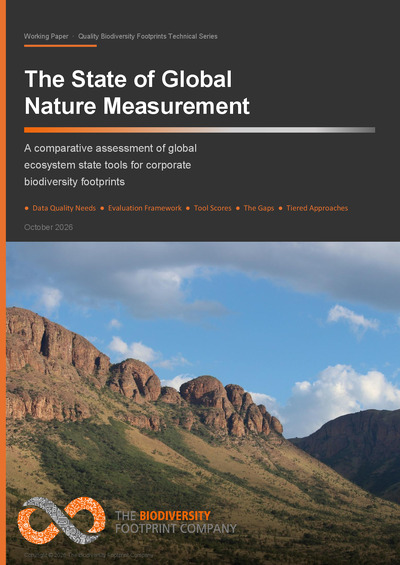
A review of 20 widely used biodiversity tools finds they’re good for spotting nature risk in a portfolio, but not for checking whether a company’s site-level nature targets are being met.
Photo credit: The Biodiversity Footprint Company
More and more companies are promising “no net loss” of nature, or even a “net positive” impact, at their operating sites. Investors are being asked to trust those claims, and soon auditors will be asked to check them. But can the data behind them actually show progress? A new working paper from The Biodiversity Footprint Company (TBFC), published during the UN biodiversity summit COP17, puts 20 widely used global biodiversity tools to the test. The answer is: not on their own. The tools are valuable for what they were built for, such as screening portfolios and flagging where nature risks sit. But they were not designed to measure what is happening to nature on the ground at a specific site, and that is exactly what a site-level target needs.
What investors should know
- A good score doesn’t mean good results on the ground. Most tools estimate nature impact from what land is used for, not from what is actually there. 85% would not register a company restoring land at its own site. A footprint score can stay flat while real progress happens, or look fine while things get worse.
- Ask what the baseline really shows. In 85% of the tools, a “2020 baseline” may blend data from many years. None can see detail finer than 300 metres, and 65% don’t say how reliable their numbers are. Ask companies which year their baseline represents, how detailed it is, and how confident they are in it.
- Be wary of nature claims built only on global models. If a company’s progress rests on a global screening tool alone, the claim is hard to verify, and that is a greenwashing and assurance risk.
- Expect site-level evidence where it matters most. Companies with high-impact sites should combine global tools for screening with satellite data and field monitoring at those sites.
References and links
- Teren, G., van der Mescht, L. and Houdet, J. (2026). The State of Global Nature Measurement: A comparative assessment of global ecosystem state tools for corporate biodiversity footprints. TBFC Working Paper. https://doi.org/10.5281/zenodo.23480572
- Full scores and evidence: https://doi.org/10.5281/zenodo.23494988
- Key findings and downloads: https://biodiversity-footprint.com/working-paper-the-state-of-global-nature-measurement/
Published by
The Biodiversity Footprint Company
