
Speeding up clean electrification and tripling global renewable energy capacity by 2030 must be key pillars of corporate and government strategies, heads of government, CEOs and civil society leaders said at Climate Week NYC.
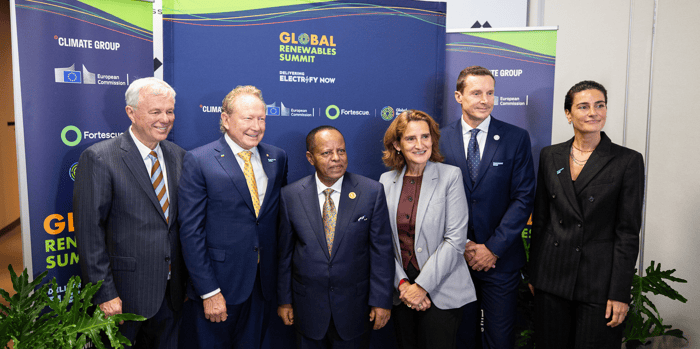
Photo credit: Climate Group
Global Renewables Summit 2026
A group of more than 20 decision-makers from government, business and civil society met behind closed doors for a High-Level Leaders Dialogue at the Global Renewables Summit, a flagship event of Climate Week NYC. The session was co-hosted by Fortescue, Global Renewables Alliance, and Climate Group.
A delegation from the COP31 Presidency, which has made reaching 35% electrification by 2035 a key ambition for the upcoming climate talks in Antalya, joined the discussion alongside global leaders such as Taye Atske Selassie, President of Ethiopia, Executive-Vice President of the European Commission Teresa Ribera, Miatta Fahnbulleh, UK Secretary of State for Energy Security and Net Zero, Dr Andrew Forrest AO Executive, Chairman and founder of Fortescue, and Executive Secretary Simon Stiell of UNFCCC.
By taking part, the leaders in the High-Level Dialogue sent a strong signal to investors, other governments, and industry colleagues worldwide that the direction is clear: Secure, reliable, resilient and affordable energy systems must be built on homegrown, clean electricity and future-proof grids.
As demand for electricity surges, only the rapid expansion of renewables can meet that demand while keeping emissions in check. This is backed by recent polling among almost 2,000 business leaders in 18 countries, which showed overwhelming business support for a rapid switch to renewables based electrified economies, supported by battery storage. Some 90% of the polled businesses expect to be largely electrified by 2035.
The leaders in the room held frank discussions about the opportunities, barriers, and the policies, conditions, and market reforms needed to boost business confidence in investing in new industries while strengthening competitiveness and resilience. They also explored the importance of international cooperation, and how governments and businesses can work together to ensure energy systems are ready for electrification and the growth of AI.
The calls align with the goals of Electrify Now, a global initiative launched in June 2026 to accelerate clean electrification through cooperation, solution-sharing, and investment mobilisation. The government coalition, coordinated by the European Commission, continues to grow and now includes Armenia, Australia, Brazil, Canada, Ethiopia, Germany, Jordan, Kenya, Palau, the Philippines, the Republic of Korea, Singapore, Türkiye, the UK, and Uruguay.
Some voices from the Summit:
"Fortescue’s Green Grid in remote Western Australia proves heavy industry can run on green power. We are building solar, wind, batteries and hundreds of miles of transmission lines at scale now to drive fossil fuels out of our iron ore mining operations and take control of our energy costs. Governments must end fossil-fuel subsidies that artificially prop up high-polluting fuels like diesel. They distort the market and work against the clear economics of going green. This is not theory. We are here. The technology is here. We are proof."
Dr Andrew Forrest AO, Fortescue Executive Chairman and Founder
"2025 was a milestone, The Secretary of State for Energy Security and Net Zero year: the world added record levels of renewable power capacity. In 2026, extreme climate impacts and a new energy crisis have made the task even more urgent. The lesson is impossible to ignore: fossil fuel dependence is not energy security - it is a liability.vNow is the time to electrify with local, cheap renewables. Governments must fast-track permitting, expand and optimise grids and scale storage. Do that, and we can protect consumers from volatile and high fossil fuel prices, whilst unlocking jobs, investment and economic growth."
Bruce Douglas, CEO, Global Renewables Alliance
"Electrification and the renewable energy transition are central to reducing Ingka Group’s reliance on fossil fuels. Today more than two-thirds of our real estate sites are no longer heated by traditional gas boilers, and our investments in renewable energy and energy efficiency provide greater control over energy supply while reducing costs. To accelerate progress, governments must create the conditions for investment and deployment at scale. This requires greater investment in grid capacity and infrastructure, simpler and more predictable permitting, stronger incentives for on-site generation and energy storage, and policies that support the renovation and electrification of buildings."
Karen Pflug, Chief Sustainability Officer, Ingka Group
You can find more information on events and announcements during the Climate Week NYC here.
Published by
 investESG
investESG
