
ESG regulations—from the CSRD to supply chain laws—frequently trigger hesitation among small and medium-sized enterprises (SMEs and MidCaps). But while large corporations are busy fine-tuning their complex ESRS reports, mid-sized companies are looking for a pragmatic solution to provide ESG data to corporate clients and financial partners.
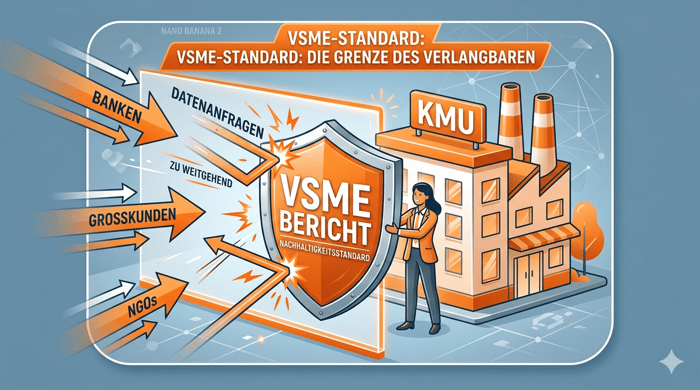
Photo credit: orangecosmos | Google Gemini Nano Banana
The VSME Standard (Voluntary Sustainability Reporting Standard) is far more than just a voluntary box-ticking exercise—it is rapidly evolving into a strategic anchor for future business viability.
The "Trickle-Down Effect" in Reality
Even if smaller businesses are not directly mandated by law to report, regulations are reaching them through the back door via the so-called trickle-down effect.
- Banks increasingly demand sustainability data as a condition for financing.
- Corporate clients require ESG proof to secure their own supply chains in compliance with the CSDDD, for their own corporate reporting, or simply during standard tendering processes.
Companies that remain silent here risk losing contracts or facing unfavorable credit terms.
VSME as a Standard and a Shield
This is precisely where the VSME standard steps in. It features a modular structure that allows companies to start at a manageable level (Basic Module) and expand over time.
The "shielding" function is particularly valuable in practice: With the implementation of the NaBeG (Nachhaltigkeitsberichterstattungsgesetz) in Austria, it has been legally established that large corporations cannot demand sustainability information from their suppliers that goes beyond the scope of the VSME standard. Consequently, your VSME report becomes a protective shield against an uncontrolled flood of bespoke questionnaires from various stakeholders.
What Belongs in the Basic Report?
The core focus of the Basic Module is highly pragmatic and centers on:
- Environment: Energy consumption, greenhouse gas emissions (Scope 1 and 2), water, and waste.
- Social: Workforce characteristics, health and safety, and fair remuneration.
- Governance: Convictions related to corruption and bribery.
To facilitate accurate data entry, a free, EU-wide Excel tool endorsed by the European Commission is available for all businesses. Setting up and documenting this (digital) data collection process once will significantly reduce the administrative workload in subsequent years.
Conclusion: From Reacting to Acting
A voluntary ESG report according to the VSME standard is not bureaucratic red tape. It enhances data quality, reduces costs in the medium term through resource efficiency, and secures long-term access to capital markets.
Before launching your sustainability report, you should clearly define its strategic objectives and derive tangible business advantages from it. A structured project plan covering the three essential phases of report preparation will provide clear guidance during implementation.
Around 80% of the required data already exists within most companies—it is simply unstructured. It is time to translate this data into a language that markets and partners understand.
Author: Mag. Andreas Gumpetsberger, MBA, Managing Partner orangecosmos - Beratungsgruppe für BW, Digitalisierung, ESG, Finanzierung, Innovation und Strategie
Published by
 investESG
investESG
