
INSIGHT by Principles for Responsible (PRI)

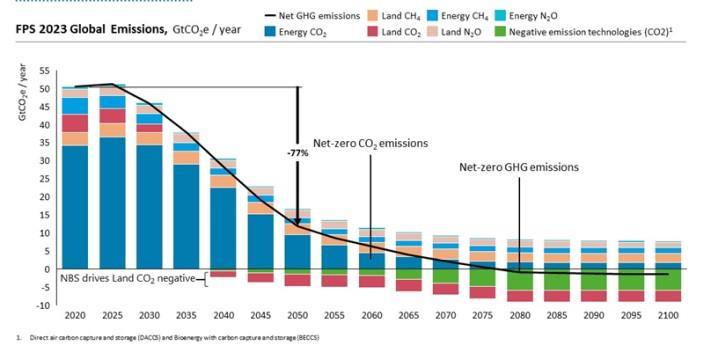 >>click to zoom in © PRI[/caption] Land is a crucial component to achieving net zero. Ruminant meat (predominantly beef and lamb) will become critical to the transition, responsible for over 20% of GHG emissions by 2050, despite the fact that it represents only ~10% of our calorific food intake. Similarly, the forecast shows an effective end to deforestation by the 2030s and significant forest restoration in the context of the broader nature targets negotiated as part of the Post-2020 Global Biodiversity Framework. IPR has launched a dedicated bioenergy study to reflect this significant sector, which links the energy and land systems.The forecast predicts that warming will breach 1.5°C by the 2030s, but peak below 1.8°C degrees higher than pre-industrial levels around 2050. This is a more optimistic future than many anticipate. Last year the UN synthesis report of government commitments, as part of the Global Stocktake (GST) process, stated that current pledges would lead to 2.5°C. As that report made clear, warming in excess of the 1.5°C lower limit of the Paris Agreement would increase systemic risks, including irreversible impacts on natural systems.The IPR forecast emphasises that these impacts drive policymakers to invest heavily in negative emissions technologies. It forecasts that these could remove 5 Gt C02/year in the latter half of the century, reducing temperatures below 1.7°C by the end of the century, and that temperatures could return to below 1.5°C around the 2120s.
 “While there is a long road to Paris, we are now well under way. The pessimism about missing 1.5°C no overshoot should not overshadow the fact that policy acceleration over the past 2 years increasingly highlights the central climate outcome is now 1.8°C warming. No time for complacency, but perhaps time for some optimism relative to previous temperature projections, despite the growing evidence of the systemic risk that comes with overshooting 1.5°C.”
-Jakob Thomä, Project Director, Inevitable Policy Response
“Climate-induced social tipping points and the Paris Stocktake-Ratchet cycles over this decade will accelerate pressure for policy makers to deliver a well below 2C outcome. This will have huge implications for investors and investment markets.”
-Mark Fulton, Founder, Inevitable Policy Response
“This new 2023 forecast from IPR demonstrates the economic transition to net zero is well underway. It offers clarity on where, when, and how policies are expected to accelerate in response to growing climate risks this decade and beyond. We encourage institutional investors to examine its findings carefully and consider the implications for their strategies.”
-Nathan Fabian, Chief Sustainable Systems Officer, PRI
What makes the FPS distinct from other scenariosIPR’s Forecast Policy Scenario is conceptually distinct from scenarios produced by the IEA or IPCC. Rather than working backwards from a hypothetical outcome (Net Zero by 2050 in the case of the IEA’s NZE scenario) or hypothetical level of climate action (continued fossil fuel-based development in the IPCC’s SSP5-8.5 scenario), the IPR forecast is constructed ‘bottom-up’, driven by a ‘high-conviction forecast’ of likely policy developments and their impact on GHG emissions and temperature.In IPR, the net zero and temperature outcomes are the product of the forecast, not the other way around.FPS 2023 was formally launched during Climate Week New York City on Thursday 21st September. Deep dive on key findings from the IPR 2023 Forecast Policy Scenario1. Net ZeroAdvanced economies reach near zero by 2050, while Emerging and Developing Economies (EMDEs) will continue to emit ~9 Gt GTCO2 in 2050, mainly from industry.Turkey and Vietnam reach net zero by 2060 and South Africa beyond 2065 despite all having 2050 targets (each country contributes 1% of global CO2 emissions). India achieves net zero CO2 emissions by 2065, accelerating 5 years ahead of its existing target.Following a mid-2020s plateau, all fossil fuel use declines, with coal, oil and gas demand falling by 66%, 62% and 52% respectively by 2050.Renewables account for 85% of global electricity generation by the 2050s.China acts on coal, retiring 60% (800GW) of its unabated coal fleet by 2045, fitting 100GW with CCS and keeping 400 GW in reserve.Bio Energy Carbon Capture and Storage (BECCS) removes 1 Gt C02/year by 2050.Direct Air Carbon Capture and Storage (DACCS) removes 0.6Gt C02/year by 2050 at a cost of $100bn and 5 Gt by 2080.Nature based solutions capture ~3.8 GTCO2/yr by 2050.2. Power 3. Negative Emissions Technologies (NETs) / Carbon Removals4. Land useLand protection reaches 30% of national land area by 2035 in North America and China, and by 2030 in Europe. Globally, an additional 980Mha of natural vegetation is protected by 2050, stabilising biodiversity intactness to 2020 levels.Brazil and Indonesia end effective deforestation by 2030 (each country contributes 25% of C02emissions from land use change), with global deforestation ending by 2035.Behavioural shifts and innovation drives consumers away from emission-intensive proteins, leading to a peak in global beef production by 2035.5. TransportEurope and China stop selling cars and vans with CO2 emissions by 2035; the US and India follow by 2040.Shipping and aviation accounts for 70% of transport emissions by 2050 despite shifting to 50% zero carbon fuels.6. Industry Deep industrial decarbonisation at scale begins by the 2030s, driven by a shift toward clean hydrogen, industrial CCS and a variety of other recycled and bio-based materials.7. BioenergyWhen considering sustainability guardrails, only 567 mha of land is available for bioenergy, of which only around 15% is used given economic and political constraints.Bioenergy without CCS is likely to be outcompeted by lower carbon alternatives in most energy system applications. As a result, bioenergy use only grows modestly in the FPS, in contrast with other prominent transition outlooks, many of which expect a larger role for bioenergy.Aviation and the pulp & paper industry are notable exceptions - a lack of cleaner alternatives and very inexpensive self-supply of waste and residues make unabated bioenergy cost competitive through to 2050. aboutThe IPR is a climate transition forecasting consortium that aims to prepare institutional investors for the portfolio risks and opportunities associated with a forecast acceleration of policy responses to climate change. To help prepare markets and investors IPR then models in detail the impact of the forecasted policies on the energy system, food & land use system, and real economy. More information is available here. 1] IPR was commissioned by the Principles for Responsible Investment (PRI)[2]Accounting for 74% of global CO2 emissions across 21 major economies[1] Predominantly beef and lamb[2] Calorific
All opinions expressed are those of the author and/or quoted sources. investESG.eu is an independent and neutral platform dedicated to generating debate around ESG investing topics.
 investESG
